Imprecise Body Grammars
As we began thinking about how we get to know bodies, we curated story books to share with the children because we thought that it was important to practice paying attention to bodies without only focusing on our own bodies. We wanted to interrupt discourses of child development that focus on children’s bodies as personal moral responsibilities and individual units ripe for assessment. We wanted, instead, to offer the idea that we could think about bodies as a collective project and as relational entities that we might care for together. We noticed that we were all – educators, children, researcher – struggling with language to talk about bodies without describing them in familiar ways. It felt like we had inadequate body grammars; we knew words like ‘big’ and ‘small’ or ‘strong and ‘fast’, but educators and I discussed how we felt that these terms were anchored in the same individualist body logic that we were trying to refuse. ‘Big’ and ‘small’ seemed to reproduce familiar thinking, where an independent ‘big’ body is different compared to a separate ‘small’ body. This language reproduces bodies as discrete entities.
At the same time, we felt compelled to resist coded or metaphorical terms that silence or romanticize bodied differences. We wondered if ‘big’ and ‘small’ might be slipping into such a practice. When we say ‘big’, what do we mean? Fat? Wide? Imposing? Strong? What does ‘big’ invoke when used in policy, child development, or curriculum frameworks? In media or in medicine? What might ‘big’ denote that has become so unwelcome that it cannot be named? If we hold that we want to do bodying pedagogies that are up to the charge of confronting complex body politics, then an important pedagogical commitment is denying the power of palatable or childish or oblique terminology that obscures the actual differences and inequities that children encounter with bodies.
Educators and I also noticed how often we described bodies using taken-for-granted measurement or quantifying referents (ex. your arm can reach so far; you can jump so high). We traced how our reliance on these measurement-based body grammars were strongly invested in comparative and competitive bodying relations. While we were not naming or measuring the direct dimensions of, for example, how high a child can (or should) jump, our turn to these referents in getting to know bodies with children slipped readily into the familiar captures of judgement: high jumps are ‘better’ than low jumps, jumping very high is a desired skill. Not only does this run a risk of reproducing bodies as discrete entities, it also foregrounds hierarchical body logics. Knowing bodies through performance-based power dynamics is, for us, a concern as it positions bodies as machines that perform or execute tasks, and – more unsettling for us – suggests that metrics should be an appropriate logic for knowing bodies. When we consider how body grammars rooted in metrics shape our experiences of bodying, we think of weight scales, the Body Mass Index, clothing size, timed 5km runs, calorie counting, and so many other relations of body control premised in quantification or numbers. These are not, for us, relations with bodies that we want to foster with children; measurement-based body grammars, we suggest, can become quite unlivable.
Tangled with this concern, we considered how our practices for using these measurement referents calibrate children’s bodies from the outside: I can see how high you are jumping. Here, I (the adult, expert, power holder) am appraising a child’s body and my assessment should mean something towards how that child gets to know their body. These body logics are located externally and, importantly, in status-quo iterations of offering measurement or quantifying referents in ECE, there is often little dialogue or shared work with children. Concomitantly, we are very cautious not to mount a dichotomous counter argument where all knowledge about bodies must come from the ‘inside’. Bodying pedagogies are relational. How inside/outside come to matter for body logics is situated and shapeshifts within different relations, inheritances, and bodies. Our question then, is how we might navigate, interrupt, refuse, reconfigure, and co-enliven incredibly complex body logics without seeking to resolve their imperfections and imprecisions as we get to know bodies with children? How do we craft vibrant and responsive bodying pedagogies when we meet body logics that are ‘on the edge’ of governance and, instead of excluding or critiquing these logics, co-create unyielding processes of engaging these edges without reproducing their inequities?
While we are unwilling to participate in doing bodies while relying strongly on comparative language or veiled words to get to know bodies, we also know that “language creates worlds” (Blaise & Pacini-Ketchabaw, 2025, p. 168) and that “it is our task to keep reading, writing, citing, and speaking as verbs in conversation with a world of material, lived consequences” (Land & Vintimilla, 2024, p. 130). Sidestepping or rejecting existing body grammars for their inadequacies or excluding comparative language to substitute in a ‘new’ vocabulary also means stripping body grammars of generativity through their imprecision. Put differently, our question around body grammars becomes “what if we do not give up on concepts when they become problematic, sticky in their alliances to neoliberal capitalism, and instead wonder what these words might create in different contexts with different ethics and politics” (p. 132). If bodying pedagogies refuse to let body grammars rest in habit and pattern, the problem of describing bodies outside of comparative language requires – as one possible proposal - agitating the ways of knowing bodies that are also congealed in habit and pattern.
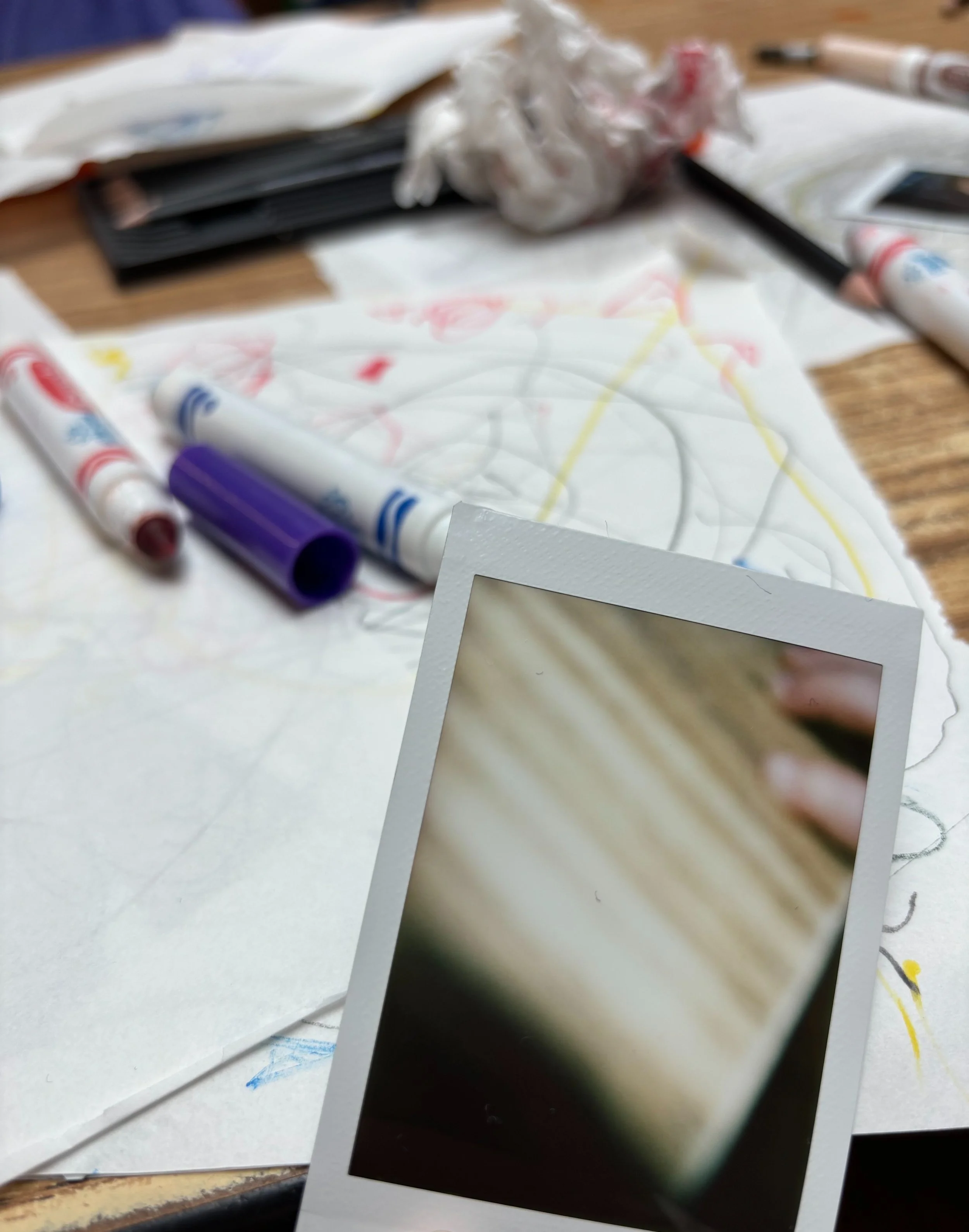
We took on the question of how we might shift our frame for attending to bodies – rather than bodies as divisible units, we wondered what might happen if we attuned to how bodies navigate space together. We quickly figured out that this is quite a difficult proposal. To try to figure out how to notice bodies otherwise, we offered children the provocation of visualizing bodies through instant polaroid camera images: what body in this image? What is it doing? What does it connect to? We invited the children to take photographs of bodies that were important, and we chose not to encourage them to take ‘accurate’ photos that show a complete or identifiable body. Together, we worked at noticing bodies in the small, blurry images without recourse to an already familiar whole body. These small polaroid pictures and our processes of creating photographs could, materially and interpretatively, not enable familiar expectations for photos to facilitate ‘accurate’ representation or exact replication: the polaroid prints are far too over exposed by an automatic flash setting and motion infuses the images with a porousness where bodies melt into backgrounds. We all hold the polaroids differently: some children bend the firm film print into a tube in their palms to ensure a firm grasp, others carry them balanced flat on their hands with great reverence, and many were victim to a researcher’s water bottle spill that made them take on the texture of a bumpy gourd but did not make the ink run. Slowly, we began to figure out how to shift our body grammars towards (or resist shifting them away from) imprecision because answering to the brilliant imprecisions co-composed with the polaroids became a proposal for getting to know bodies otherwise.
We noticed and followed one slippery event towards shifting body grammars through an un-anticipated polaroid photo curational process. We spread our stack of polaroid photos from multiple past weeks over a table and one of the children suggested that we could ‘make bodies’, creating an emergent curational process where polaroids were gathered and dispersed. The researcher and an educator took on the role of dealer, handing photos to children and – as subjects so immersed in seeking justification – asked ‘why do these two photos go together?’. Nobody responded with language; moving the photos around continued. ‘Can these go together?’, an educator asked, layering two polaroids on top of one another. One of the children adjusted how the photos were layered, sliding one sideways, and nodded. As different polaroids were placed, adjusted, moved, dropped, and covered, ‘yes’ and ‘no’ became a grammar of this polaroid-positioning process. Vocabularies of description and justification (ex. ‘why do these go together?’) did not make sense, while ‘no’ incited continual movement to find a photo a resting place and ‘yes’ expanded a mobile body-visibilizing in process.
‘Yes’ and ‘no’ as grammars are profoundly imprecise. They are also, as words and proposals for getting to know bodies with children, deeply intricate and non-innocent. ‘No’ and ‘yes’ can be bearers of exclusion, approval, and desirability. Control, discipline, and power also link through histories of ‘yes’ and ‘no’ body logics. That ‘yes’ and ‘no’ are criteria for assessing normativity – yes, that is normal; no, that is abnormal – matters too. At the same time, to the Eurocentric intellectual subject rich in critical thinking and judicious debate, ‘yes’ and ‘no’ are hauntingly unscientific. We cannot, such a dominant logic might argue, get to know bodies with children based on ‘yes’ and ‘no’ as there is no appeal to the extant logics that structure dominant body relations (ex. desirability, competition, moralism). The question of what relations and practices for doing and knowing bodies are made possible by ‘yes’ and ‘no’ is entirely situated. This grammar walks multiple edges, running the risk of tumbling into reiterating incalculable extant body relations and unjust body categorizations – and, in thinking with creating imprecise body grammars, where thinking outside of steadfast interpretations that fossilize bodies as known and knowable is our intention, that ‘yes’ and ‘no’ are contingent and consequential body grammars is what makes them interesting to wrestle with. ‘Yes’ and ‘no’ cannot solve the trouble of bodied lexicons. We cannot trust ‘yes’ or ‘no’ to do the work of reshaping bodying pedagogies with children. Their imprecision is, accordingly, eventful for answering to the questions bodying pedagogies require we face.
In this event, as responsive gestures for ‘making’ bodies with polaroid photos, ‘yes’ and ‘no’ do not designate difference as binary as comparative logics do nor do they assign an already-familiar title based on an already-familiar scale (ex. width, length) or necessitate an already-known logic and elaboration (ex. that reaches higher and is, therefore, taller). ‘Yes’ and ‘no’, as bodying grammars created nourished by terribly messy generative polaroid photos, do not owe to any singular universal pre-determined logic and they do not require a rationale to motivate or substantiate a curational co-creation process. ‘Yes’ and ‘no’, in this moment, do not solve a question; they do not close the work of ‘figuring out’ that is created as we work at getting to know bodies together with polaroid pictures. This is critically important: our ‘yes’ or a ‘no’ are offered with a faith that there will be a question or photo or layering to follow within, and that will – somehow, which we have to figure out again and again – sustain our collective work. Without the taken-for-granted authority to definitively stop uncertainty that we ascribe to ‘yes’ or ‘no’, these grammars become, here, imprecise but not hollow or indeterminate. This does not mean that ‘yes’ and ‘no’ are better (ex, less problematic, less violent, more just, more generous) grammars that we can rely on, through time, for getting to know bodies otherwise with children, nor does it permanently walk ‘yes’ and ‘no’ away from their colloquial conclusive uses and relations with exerting power or refusal. What we want to highlight is that, in this moment, our experiment in generating otherwise body grammars requires a collective, incessant negotiation of what a ‘yes’ and a ‘no’ invite in relation with the histories and movements and materialities of the photos, film, hands, spilled water, and ECE structures and discourses and relations that take shape and are shaped by ‘yes’ and ‘no’.
Studying body grammars emphasize, in our work, the ongoing work of bodying pedagogies: what body relations and logics – and worlds – are made possible and impossible with different imprecise body grammars in ECE? What processes of doing bodies together with children might we create if we hold imprecise body grammars as a proposal for agitating status-quo body vocabularies in ECE? If we assert that co-creating imprecise body grammars might move us into the labour of doing bodying pedagogies with children, what does this lexical inconclusiveness resist (or, make unimaginable) for dominant biopedagogies, body curriculum, and normative child development? How might, for example, murky and risky body grammars like ‘yes’ and ‘no’ hinder deterministic, individualized conceptions of the good (healthy), responsible (fit) moral child-citizen? How might imprecision, as an ethic of knowing bodies, contribute to the project of co-creating and sustaining more emplaced, fleshed, responsive, affirmative, and ever shapeshifting bodying pedagogies with children? This question of inventing unfamiliar bodied grammar towards otherwise body-making curriculum is one we continue to work at.